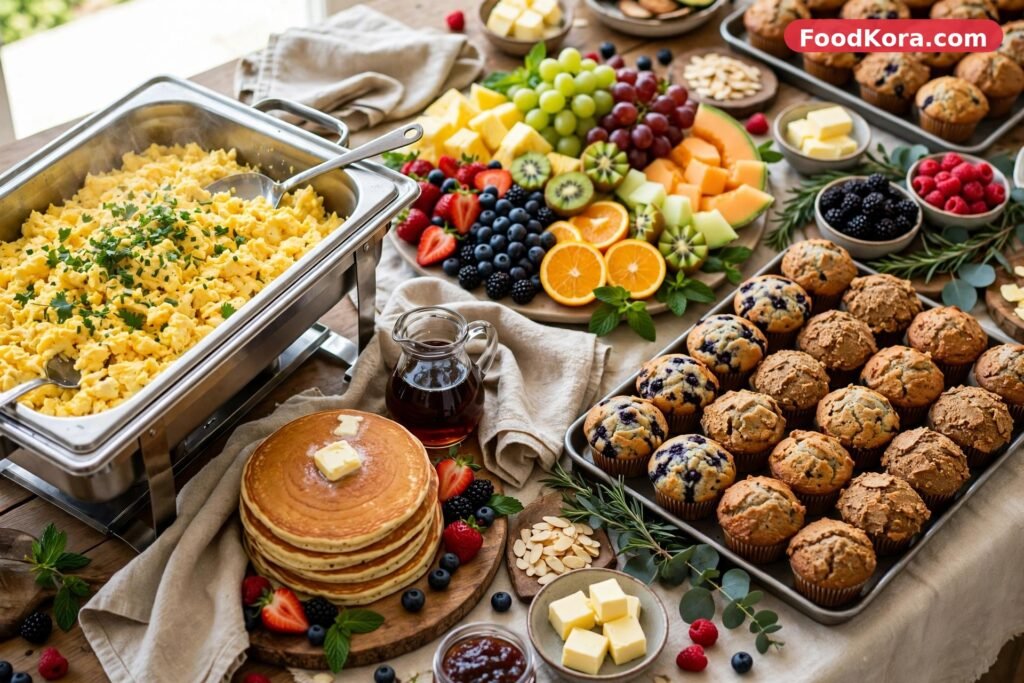

Cooking breakfast for two is easy. Cooking breakfast for ten is a different job entirely. Suddenly you need more pans, more plates, more coffee, and a plan for keeping everything warm while the last batch finishes. Without a plan, the host ends up stuck at the stove while everyone else enjoys the morning.
The good news is that breakfast ideas for a crowd do not have to be complicated. The trick is choosing recipes that scale up gracefully. A dish that doubles easily, bakes in one big tray, or sits happily on a buffet table will always beat a recipe that needs your full attention for every single serving.
This guide covers six large-batch breakfasts that work for 8 to 12 people, plus a simple timeline so you know what to do the night before, what to do first thing, and what can wait until guests arrive. Pick two or three recipes, add coffee and fruit, and you have a full breakfast spread without spending the whole morning cooking.

Why Do Big-Group Breakfasts Need a Different Plan?
A recipe that serves four does not simply double when you cook for twelve. Pans get crowded, cooking times stretch, and the first servings go cold before the last ones are ready. Crowd cooking works best when you change the method, not just the quantities.
Tray bakes are the hero of group breakfasts. A sheet pan of eggs, a tray of baked oatmeal, or a breakfast casserole all cook in one go, serve many people, and stay warm in the oven while you set the table. Compare that with pancakes made one at a time, and the advantage is obvious.
Buffet-style serving helps just as much. Instead of plating every portion yourself, set the food out and let guests serve themselves. It feels relaxed rather than formal, it lets people eat at their own pace, and it frees you to actually sit down and enjoy the meal.
How Much Food Do You Need for 8 to 12 People?
A useful rule is to plan one main dish per four guests, plus one shared side and one fruit option. For ten people, that might mean a breakfast casserole, a tray of baked oatmeal, a big fruit platter, and bread or muffins. Add coffee, tea, and juice, and nobody goes hungry.
For eggs, count two per person if eggs are the main dish, or one per person if they are part of a bigger spread. For baked goods, plan two muffins or two pancakes per person, since people tend to take seconds of the easy-to-grab items. For drinks, a large pot of coffee plus a jug of juice usually covers a group of ten, with tea as a backup.
It is better to have a little extra of one simple thing than to run short on everything. A big bowl of fruit or an extra tray of muffins is cheap insurance, and leftovers from those are easy to keep. Running out of the main dish halfway through breakfast is the one mistake guests always remember.
What Should You Do the Night Before?
The night before is when a calm group breakfast is won or lost. Doing even an hour of prep in the evening turns a frantic morning into a relaxed one, and most of the work below takes less time than you expect.
First, set the table and lay out the serving dishes, plates, cutlery, and glasses. It sounds small, but hunting for a serving spoon while eggs are in the oven is exactly the kind of stress you can avoid. Put out anything that does not need the fridge: bread, cereals, coffee, and tea.
Next, prep the ingredients. Chop vegetables, grate cheese, mix dry ingredients for muffins or pancakes, and assemble any casserole that can rest overnight in the fridge. Many egg casseroles actually taste better after a night in the fridge, because the bread soaks up the egg mixture properly.
Finally, write a short timeline on a sticky note: what goes in the oven first, what needs the most time, and what can be done last. When you wake up, you follow the note instead of trying to plan while half asleep. That one habit alone makes group breakfasts feel manageable.
Recipe 1: Sheet-Pan Eggs for a Crowd
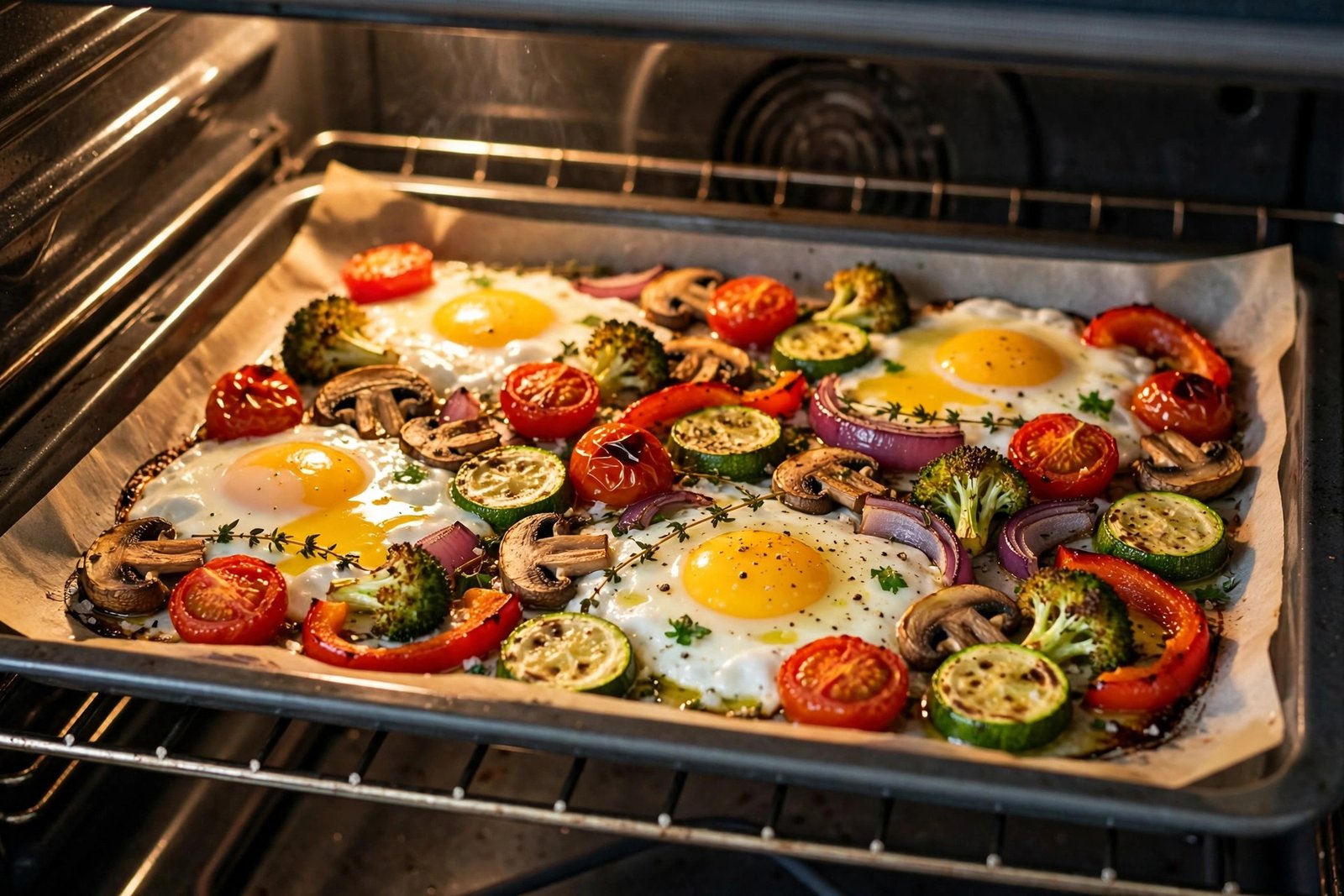
Sheet-pan eggs are the fastest way to cook eggs for a group. Instead of standing over a frying pan making batch after batch, you pour the mixture into a large rimmed baking tray and let the oven do the work.
Whisk twelve eggs with a splash of milk, salt, and pepper until well mixed. Pour the mixture into a greased rimmed sheet pan, scatter over diced peppers, spring onions, and a handful of grated cheese, and bake at 180 degrees Celsius for about fifteen minutes, until just set in the middle.
Let the eggs rest for two minutes, then slice into squares and serve straight from the tray. You can change the fillings to suit your guests: mushrooms and spinach for a lighter version, or diced ham and cheese for a heartier one. The squares stack neatly on a buffet table and stay warm under foil for twenty minutes.
Recipe 2: Big-Batch Pancakes Without the Wait
Pancakes are a crowd favourite, but making them one at a time for twelve people takes forever. The solution is to bake them as a single tray instead, which gives you the same flavour with a fraction of the effort.
Whisk together two cups of flour, two tablespoons of sugar, two teaspoons of baking powder, and a pinch of salt. In a separate bowl, beat two eggs with one and a half cups of milk and a spoonful of melted butter, then combine with the dry ingredients until just mixed. A few small lumps are fine.
Pour the batter into a greased rimmed baking tray, scatter berries or banana slices over the top, and bake at 180 degrees Celsius for about fifteen minutes until golden and springy. Cut into squares and serve with maple syrup, honey, and extra fruit on the side. One tray serves about eight people generously, so make two trays for a group of twelve.
Recipe 3: Baked Oatmeal Tray
Baked oatmeal is one of the most forgiving crowd breakfasts, because it can be assembled the night before and baked in the morning while you make coffee. It also suits guests with different tastes, since the toppings are added at the table.
Mix three cups of rolled oats with two teaspoons of baking powder, a teaspoon of cinnamon, and a pinch of salt. In another bowl, whisk two eggs with two cups of milk, a quarter cup of honey, and a spoonful of oil or melted butter. Combine everything, stir in a cup of berries or sliced banana, and pour into a greased baking dish.
Cover and refrigerate overnight if you like, or bake straight away at 180 degrees Celsius for thirty to thirty-five minutes, until the top is golden and the centre is set. Serve in squares with yogurt, extra fruit, and honey on the side, so each guest can finish their portion the way they like it.
Recipe 4: Make-Ahead Breakfast Casserole
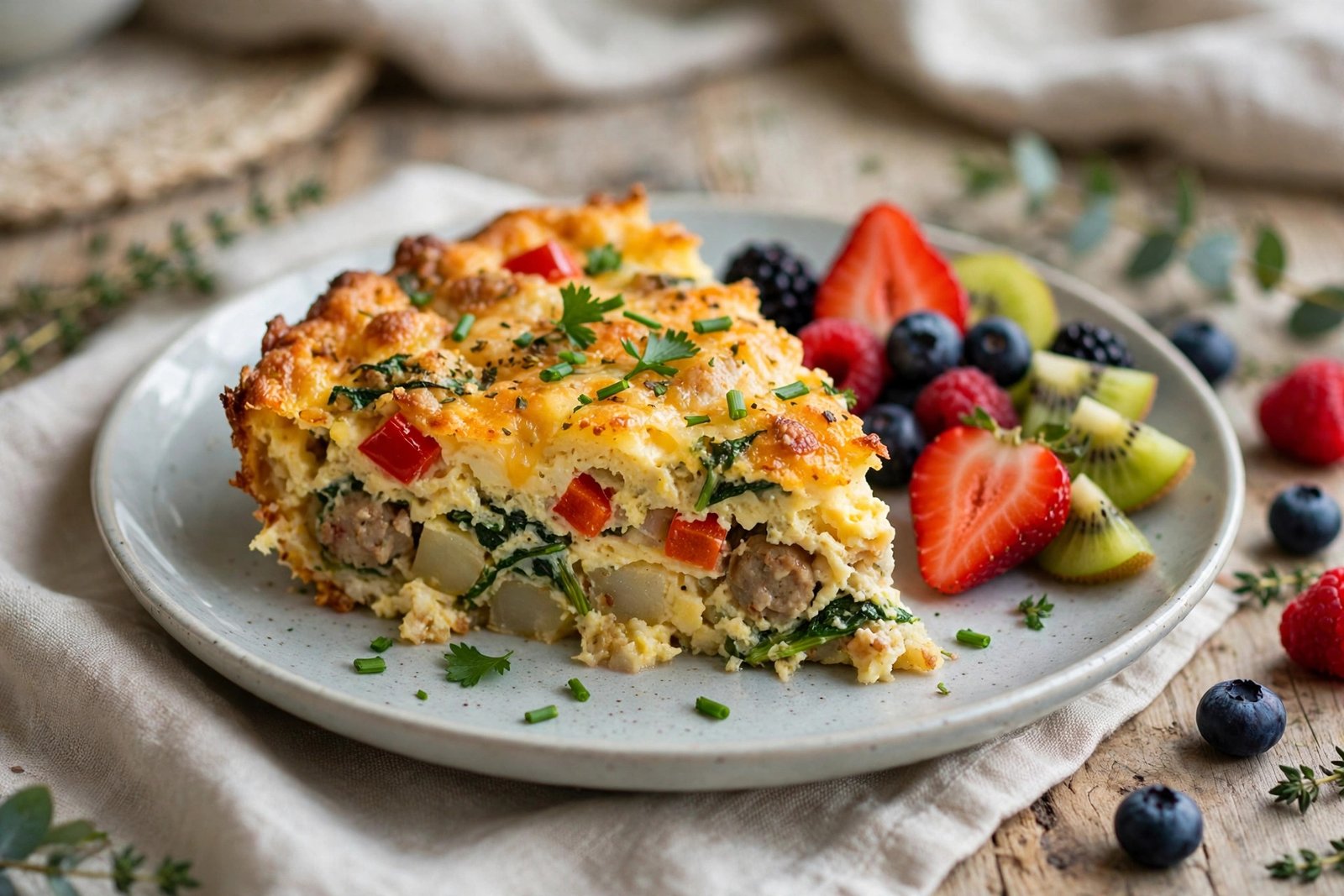
A breakfast casserole is the classic group breakfast for a reason. It feeds a crowd from a single dish, it can be assembled the night before, and it looks generous on a buffet table with almost no effort on the day.
Tear a loaf of day-old bread into chunks and place them in a large greased baking dish. Scatter over a cup of grated cheese, a cup of chopped vegetables such as peppers and spinach, and cooked sausage or mushrooms if you want a heartier version. Whisk ten eggs with two cups of milk, salt, pepper, and a spoonful of mustard, then pour over the bread and press down gently.
Cover and refrigerate overnight so the bread soaks up the egg mixture. In the morning, bake uncovered at 180 degrees Celsius for forty to forty-five minutes, until puffed and golden. Let it rest for ten minutes before slicing, which helps it hold together when served. One large casserole serves eight to ten people easily.
Recipe 5: Fruit Platter and Yogurt Bar
Every crowd breakfast needs something fresh and light alongside the hot dishes, and a fruit platter with a yogurt bar fills that role perfectly. It needs no cooking, it suits almost every diet, and it looks impressive with very little work.
Arrange sliced melon, berries, grapes, banana, and orange segments on a large platter or board, grouping each fruit together so the colours stand out. Put a big bowl of plain yogurt next to it, with smaller bowls of oats, nuts, seeds, and honey for toppings. Guests build their own bowls, which means nobody has to ask for a special version.
Make the platter the morning of the breakfast, since cut fruit is best fresh. Keep it covered in the fridge until serving time, and put it out last so it stays cool. For a group of twelve, plan roughly two large platters of fruit and a litre of yogurt, and expect both to disappear quickly.
Recipe 6: Muffin Batches That Feed Everyone
Muffins are the easiest crowd breakfast to scale, because a single batch makes twelve and a double batch makes twenty-four. They also travel well, freeze well, and suit guests who arrive at different times, since they taste good warm or at room temperature.
Use a simple base: mash three ripe bananas, stir in three eggs, half a cup of honey, and half a cup of oil, then add two cups of oats, one and a half cups of flour, two teaspoons of baking powder, and a pinch of salt. Mix until just combined, add a cup of blueberries or chocolate chips, and spoon into lined muffin tins.
Bake at 180 degrees Celsius for twenty to twenty-two minutes, until golden and springy. Make the muffins a day ahead if you like, and warm them briefly in the oven before serving. For a mixed crowd, bake one sweet batch and one savoury batch with cheese and herbs, so there is something for every taste.
How Do You Set Up a Breakfast Buffet?
A good buffet layout saves more time than any recipe. Put plates and cutlery at the start, then the hot dishes, then bread and sides, then fruit and yogurt, and finally drinks at the end. Guests move in one direction without bottlenecks, and the hot food stays at the front where it is easiest to reach.
Keep hot dishes warm by leaving them in the oven at a low temperature until serving time, then covering them with foil on the table. A second oven shelf, or a slow cooker on its warm setting, can hold a casserole while the first tray of eggs finishes. Avoid leaving cooked eggs or dairy dishes out at room temperature for more than two hours, following general food safety guidance.
Label anything that matters: a small card saying “contains nuts” or “vegetarian” saves guests from having to ask, and it makes the table look thoughtful rather than thrown together. Put drinks in a separate spot if space allows, so people refilling coffee do not block the food queue.
What About Guests with Different Diets?
Most groups include at least one guest who eats differently, and the easiest answer is to make one dish that suits everyone and label the rest. A fruit platter and yogurt bar already covers many diets, and a vegetable-filled baked oatmeal can be made without dairy by using oat milk.
For gluten-free guests, offer rice-based or naturally gluten-free options rather than trying to convert every recipe. Fruit, eggs, and yogurt are safe choices, and a separate small tray of gluten-free muffins keeps things simple. For vegetarians, keep the meat out of at least one main dish and label the meat version clearly.
Ask about allergies and strong preferences when you invite people, not on the morning itself. A quick message beforehand lets you plan one safe dish instead of scrambling to adapt everything at the last minute. Guests notice that kind of thoughtfulness far more than they notice a fancy menu.
A Simple Timeline for the Morning
A timeline turns a crowd breakfast from chaos into routine. The night before, assemble the casserole, mix the muffin batter or bake the muffins, chop vegetables, set the table, and put out the serving dishes. That evening work is the biggest gift you can give your morning self.
On the morning, start with the dish that takes longest. Put the casserole in the oven first, then bake the oatmeal or sheet-pan eggs while the casserole rests. Warm the muffins last, set out the fruit platter, and make coffee while the final tray bakes. Everything lands on the table within a few minutes of each other.
If guests arrive at different times, keep the food in the oven on low and let people serve themselves as they arrive. A buffet handles staggered arrivals far better than a sit-down plated meal, and it keeps the morning relaxed for everyone, including the host. For more simple everyday meal planning, our guide to easy meal recipes shows how the same batch-cooking approach works for lunches and dinners too.
You May Also Like
Frequently Asked Questions
How many breakfast dishes should I make for 10 people?
Two main dishes plus fruit and bread is usually enough for ten people. One hot egg dish and one baked dish, such as a casserole and baked oatmeal, gives variety without overloading the kitchen. Add coffee, juice, and a fruit platter, and most groups will be well fed.
Can I cook everything the night before?
Some dishes, like casseroles and muffin batter, can be assembled the night before and baked in the morning. Fruit should be cut fresh on the day, and eggs are best cooked fresh or reheated gently. A mix of overnight prep and morning baking gives the best results with the least stress.
How do I keep breakfast warm for a crowd?
Use the oven on its lowest setting to hold finished dishes, and cover trays with foil to stop them drying out. Cook dishes in order of cooking time, longest first, so everything finishes close together. Avoid leaving cooked eggs and dairy dishes out at room temperature for more than two hours, following USDA food safety guidance.
What is the cheapest breakfast for a large group?
Oat-based dishes, eggs, and fruit are the most affordable crowd breakfasts. Baked oatmeal and sheet-pan eggs cost very little per person, and a big fruit platter stretches further than individual pastries. Muffins baked at home are also far cheaper than bought ones for a group.
How do I handle guests arriving at different times?
A buffet is the best format for staggered arrivals, because food can stay warm in the oven and guests serve themselves when they arrive. Keep the hot dishes covered, put drinks in a separate spot, and avoid a formal sit-down start time. Late arrivals still get a full breakfast without disrupting everyone else.
Conclusion
Feeding a crowd at breakfast is mostly about choosing the right recipes and doing the right work the night before. Tray bakes, casseroles, and buffet sides scale up without drama, and a simple timeline keeps the morning calm. You do not need a bigger kitchen or professional skills — just dishes that serve many people at once and a plan for when each one goes in the oven.
Start with two recipes from this guide, add fruit and coffee, and let guests serve themselves. Once you have cooked for a crowd once, the second time feels easy, and breakfast becomes the most relaxed meal of the gathering rather than the most stressful. For more crowd-friendly cooking ideas, USDA MyPlate guidance is a useful reference for balanced, affordable meals.


