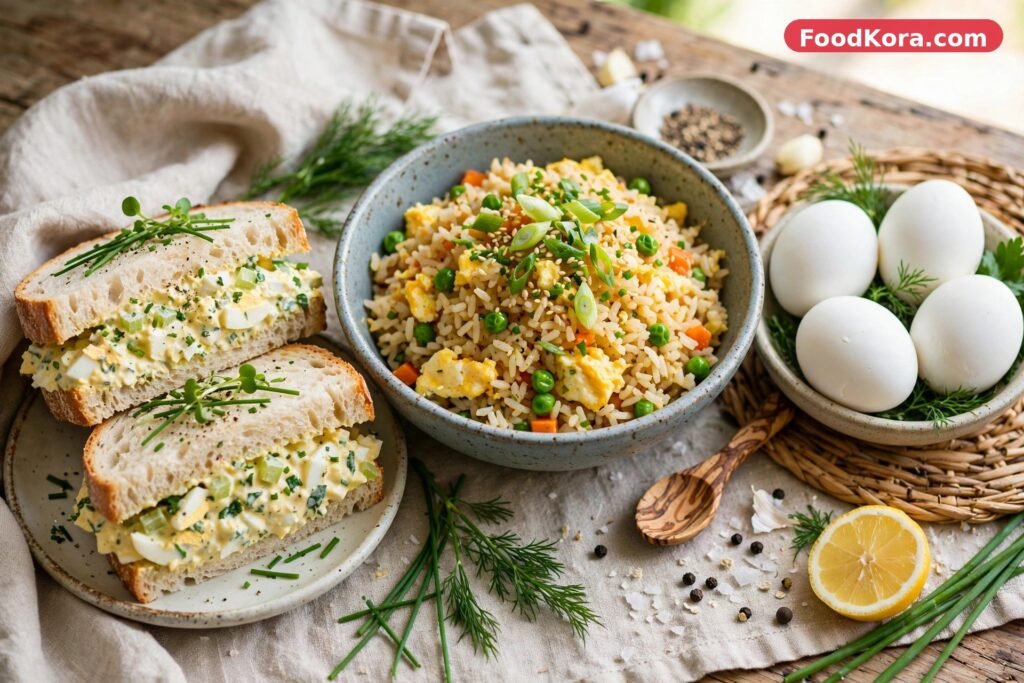

Eggs are easy to think of as a breakfast food, and then forget about for the rest of the day. That is a shame, because a carton of eggs is one of the most useful things in the kitchen. They cook fast, they cost very little, and they can turn leftovers, bread, or a handful of vegetables into a proper meal at any hour.
If you have ever opened the fridge, seen a box of eggs, and thought, “what to make with eggs besides scrambled eggs again?” — this guide is for you. Below you will find the egg basics worth knowing, then six original recipes that use eggs for lunch, dinner, and snacks. None of them need fancy equipment, and all of them use everyday ingredients.
The best part is that these recipes are forgiving. Eggs do not demand perfection. A stir-fry that is a little rustic still tastes great, and a sandwich made with yesterday’s boiled eggs is still a good lunch. Start with whichever recipe sounds easiest, and work your way through the rest.

What Should You Know Before Cooking with Eggs?
Fresh eggs make everything easier. Check the date on the carton, and discard any egg with a cracked shell or an unusual smell. Keep eggs refrigerated and take out only what you need, because eggs that sit out on the counter for hours are not worth the risk.
Boiling is the skill that unlocks half the recipes in this guide, so it is worth getting right. Put eggs in a saucepan in a single layer, cover with cold water by about an inch, and bring to a gentle boil. Then turn off the heat, cover the pan, and let the eggs sit for nine to ten minutes for firm yolks. Cool them in cold water before peeling, which stops the cooking and makes the shells come off more easily.
Storage matters just as much as cooking. Hard-boiled eggs in their shells keep in the fridge for up to a week, which makes them one of the most convenient foods you can prepare in advance. Once peeled, eat them within two days and keep them covered. Cooked egg dishes, like fried rice or a stir-fry, should be cooled quickly, stored in a sealed container, and eaten within two to three days. General food safety guidance from the USDA stresses the same basics: keep eggs refrigerated, cook them until set, and avoid leaving cooked eggs out at room temperature for more than two hours.
How Can Leftover Eggs Save a Meal?
Leftover eggs are a quiet superpower. A few boiled eggs from Sunday can become Monday’s lunch, Tuesday’s sandwich filling, and Wednesday’s fried rice topping. The trick is to boil a few more than you need, on purpose, and keep them in the fridge ready to use.
This approach also cuts food waste. Instead of a lonely egg sitting in the carton until it goes off, it becomes part of a planned meal. Peel a batch, store them in a covered container, and think of them as a ready-made ingredient rather than a leftover. They slice into salads, mash into sandwiches, and crumble over grain bowls with almost no effort.
If you are short on time all week, a Sunday egg-boiling session is one of the simplest habits you can build. Ten minutes of work gives you a protein that is ready for days, and it makes every recipe below faster, because the eggs are already cooked when you start.
Recipe 1: Classic Egg Salad Sandwich
An egg salad sandwich is the simplest answer to what to make with eggs, and it is a lunch worth taking seriously. It takes about ten minutes, needs no cooking on the day if the eggs are already boiled, and tastes far better homemade than shop-bought.
Peel three hard-boiled eggs and chop them roughly — not too fine, because a little texture is what makes egg salad good. Put them in a bowl with two tablespoons of mayonnaise, a teaspoon of mustard, a pinch of salt, and plenty of black pepper. Mash lightly with a fork, leaving some larger pieces of egg visible, and stir in a spoonful of chopped spring onions or chives if you have them.
Spread the mixture generously over two slices of bread. Wholemeal bread works well, but any bread you like will do. Add lettuce or sliced tomato if you want freshness, then top with the second slice and press down gently. Cut in half and serve straight away, or wrap in foil for a packed lunch.
For variety, try adding a pinch of paprika, a squeeze of lemon, or a few capers to the mixture. Each small change gives the sandwich a different character, and none of them take more than a minute. Egg salad also makes a good filling for wraps and rolls, so the same mixture can cover several lunches in a week.

Recipe 2: Quick Egg Fried Rice
Egg fried rice is the fastest dinner in this guide, and it is the best way to use up cold rice. It takes about ten minutes from start to finish, and it turns a few basic ingredients into a meal that feels far more generous than it should.
Heat a tablespoon of oil in a large frying pan or wok over medium-high heat. Add two beaten eggs and scramble them quickly into small pieces, then remove them to a plate. In the same pan, fry one chopped onion and a handful of frozen mixed vegetables for three minutes, until softened and lightly golden.
Add three cups of cold, cooked rice and stir-fry for three to four minutes, breaking up any clumps, until the rice is hot and starting to crisp at the edges. Stir the scrambled egg back in, add a splash of soy sauce and a drizzle of sesame oil if you have it, and taste before adding more seasoning. A pinch of chilli flakes gives it warmth without changing the recipe.
Cold rice works best, because it fries rather than steaming into a mush. If you only have freshly cooked rice, spread it on a tray for ten minutes to cool and dry slightly before frying. A fried egg on top turns the dish from a side into a full dinner, and a handful of spring onions scattered at the end adds colour and crunch.
Recipe 3: Egg and Vegetable Stir-Fry
A stir-fry is a good answer when you want something hot, fast, and full of vegetables, and eggs make it filling without adding meat. This version uses whatever vegetables you have, so it changes with the fridge and never gets boring.
Heat a tablespoon of oil in a large pan over medium-high heat. Add sliced peppers, mushrooms, and a handful of green beans, and stir-fry for four to five minutes until just tender. Push the vegetables to the edges of the pan, pour in three beaten eggs, and scramble them gently in the middle until just set, then stir everything together.
Season with a splash of soy sauce, a squeeze of lemon or lime, and a pinch of black pepper. Serve over rice or noodles, or eat it on its own with a slice of bread. The eggs coat the vegetables lightly and bind the whole dish together, which makes it feel complete rather than like a side that is missing something.
For extra flavour, add garlic and ginger at the start, or a spoonful of chilli sauce at the end. The recipe is deliberately simple so you can adjust it every time: change the vegetables, change the sauce, and you have a different dinner from the same basic idea.
Recipe 4: Baked Eggs in Tomato Sauce
Baked eggs in tomato sauce feel like a special dinner, but they are really just eggs poached in a simple sauce in the oven. The sauce does most of the work, and the result is warm, saucy, and perfect with bread for scooping.
Warm a tablespoon of olive oil in an ovenproof pan over medium heat. Soften one chopped onion and one chopped pepper for about five minutes, then add two garlic cloves, a teaspoon of paprika, and a pinch of cumin. Cook for one minute until fragrant, then pour in a tin of chopped tomatoes, season with salt and pepper, and simmer for ten minutes until slightly thickened.
Make four small wells in the sauce and crack an egg into each one. Transfer the pan to an oven heated to 190 degrees Celsius and bake for eight to ten minutes, until the whites are set but the yolks are still soft. Scatter fresh herbs on top and serve straight from the pan with warm crusty bread.
This dish is easy to stretch. Add a tin of chickpeas or beans to the sauce for a heartier version, or a handful of spinach stirred in before the eggs go on top. It also reheats reasonably well, which makes it a good option for a second meal the next day if you make a double batch of sauce.
Recipe 5: Warm Egg Noodle Bowl
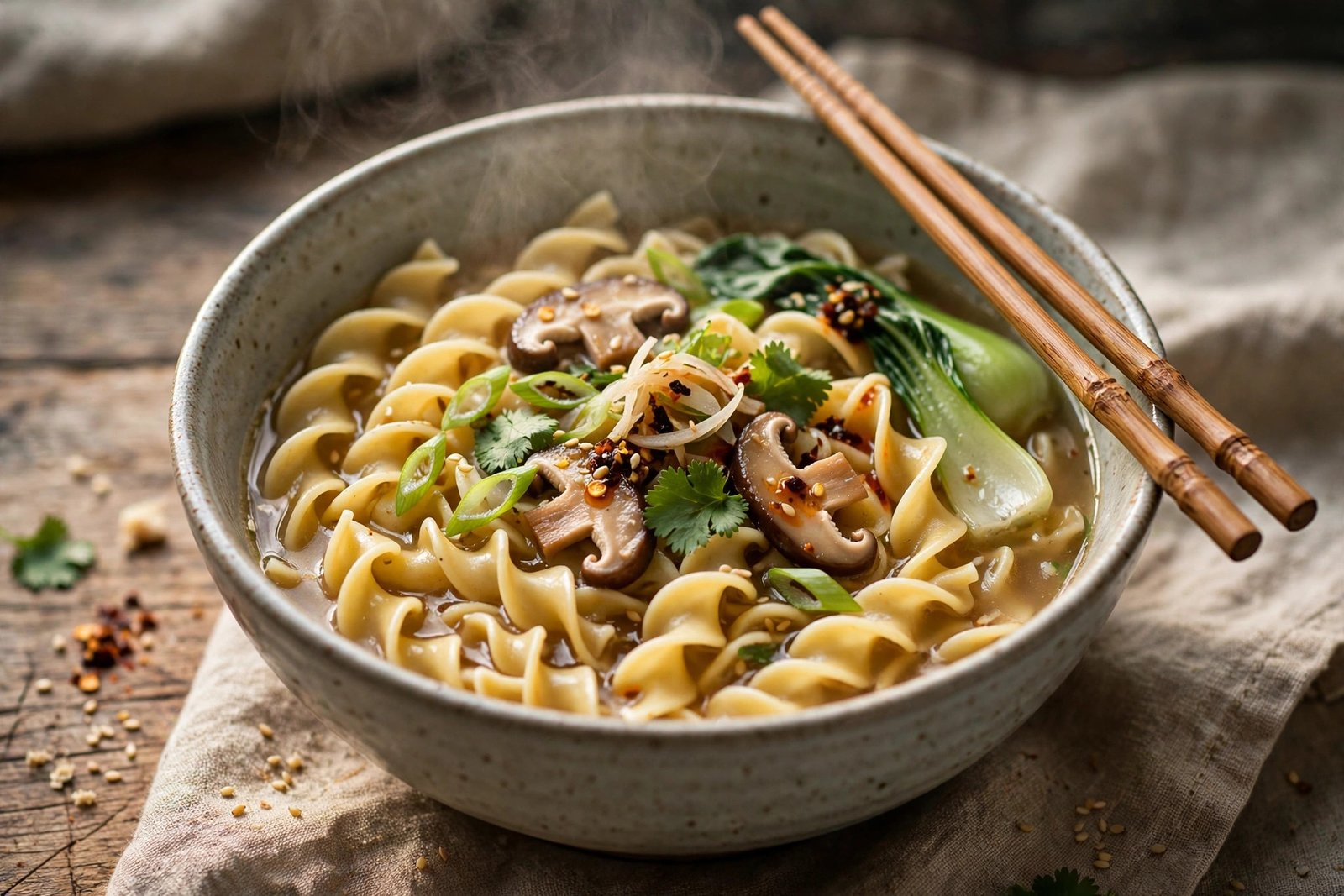
An egg noodle bowl is comfort food in its simplest form: soft noodles, a rich broth, and a jammy boiled egg on top. It takes about fifteen minutes, and it works for lunch or a light dinner.
Cook a portion of noodles according to the packet, then drain and set aside. In the same pot, warm a litre of stock — chicken or vegetable both work — with a splash of soy sauce and a pinch of ginger if you have it. Let it simmer gently for a few minutes while you halve two soft-boiled eggs, cooked for about seven minutes so the yolks stay slightly runny.
Divide the noodles between bowls, ladle over the hot stock, and top with the egg halves, spring onions, and a handful of greens such as spinach or pak choi, which will wilt in the heat. A drizzle of chilli oil or sesame oil at the end adds warmth and depth.
The beauty of a noodle bowl is that it welcomes leftovers. Shredded chicken, leftover vegetables, or a spoonful of sweetcorn all fit happily in the same bowl. Keep the broth simple and let the egg be the star, and you have a meal that feels far more considered than the effort it took.
Recipe 6: Devilled-Style Eggs for Snacks and Parties
Devilled-style eggs are the classic party snack, and they are also a great way to use up boiled eggs that need eating. They look impressive, take about fifteen minutes, and disappear faster than almost any other finger food.
Peel six hard-boiled eggs and slice them in half lengthways. Scoop the yolks into a bowl and mash them with two tablespoons of mayonnaise, a teaspoon of mustard, a pinch of salt, and a little paprika. Taste and adjust: a squeeze of lemon brightens the mixture, and a dash of hot sauce gives it a gentle kick.
Spoon or pipe the yolk mixture back into the egg white halves, and finish with a dusting of paprika and a few chopped chives on top. Arrange on a plate and keep chilled until serving. They are best eaten the same day, and they travel well in a covered container, which makes them a reliable choice for picnics and gatherings.
For a lighter version, replace half the mayonnaise with plain yogurt. The filling stays creamy but feels fresher, and the tang of the yogurt works well with the mustard. Either way, devilled eggs prove that a simple boiled egg, with a little attention, can become the best thing on the table.
How Do You Build a Whole Meal Around Eggs?
Eggs work best as part of a plate, not the whole plate. Pair them with something fresh, something filling, and something with crunch, and the meal feels complete. A fried rice with vegetables, a noodle bowl with greens, or a sandwich with salad all follow the same pattern: egg for protein, vegetables for freshness, and bread, rice, or noodles for staying power.
It also helps to think about texture. Soft eggs love crispy partners: toast, roasted potatoes, or crunchy vegetables. A plate that mixes soft and crisp is far more satisfying than one that is all soft, which is why a sandwich with lettuce or a stir-fry with spring onions works so well. One crunchy element is often all a simple egg dish needs.
For more everyday cooking built on the same simple approach, our guide to easy meal recipes (https://foodkora.com/easy-meal-recipes/) covers straightforward meals for the whole day, while breakfast recipes with eggs (https://foodkora.com/breakfast-recipes-with-eggs/) shows how the same techniques work in the morning. If evenings are the struggle, fast and easy dinner recipes (https://foodkora.com/fast-and-easy-dinner-recipes/) has more quick options for busy nights.
You May Also Like
- Easy Meal Recipes (https://foodkora.com/easy-meal-recipes/)
- Breakfast Recipes with Eggs (https://foodkora.com/breakfast-recipes-with-eggs/)
- Fast and Easy Dinner Recipes (https://foodkora.com/fast-and-easy-dinner-recipes/)
Frequently Asked Questions
What is the easiest thing to make with eggs?
An egg salad sandwich or scrambled eggs on toast are the easiest options, both ready in about ten minutes. If the eggs are already boiled, the sandwich takes even less time, since there is no cooking at all on the day. Both are good starting points for anyone new to cooking with eggs.
Can I use eggs for dinner, not just breakfast?
Yes, eggs make excellent dinners. Fried rice, stir-fries, baked eggs in tomato sauce, and noodle bowls are all satisfying evening meals that happen to be built around eggs. They are fast, affordable, and filling, which makes them ideal for busy weeknights.
How long do boiled eggs last in the fridge?
Hard-boiled eggs in their shells keep in the fridge for up to a week. Once peeled, they should be eaten within two days and kept covered. Cooked egg dishes, like fried rice or a stir-fry, should be eaten within two to three days and never left out at room temperature for more than two hours.
What can I make with a lot of leftover eggs?
Boil them and use them across the week: egg salad sandwiches, devilled eggs, sliced eggs over salads and grain bowls, or chopped eggs stirred into fried rice. Boiling a batch on Sunday is one of the simplest ways to make weekday meals faster, since the protein is already cooked and ready.
Are eggs safe to eat with a runny yolk?
A runny yolk is a personal choice, and many people enjoy it. The safest approach is to use fresh, properly refrigerated eggs and to cook the white until fully set. People who are pregnant, very young, elderly, or have weakened immune systems should choose fully cooked eggs, following USDA food safety guidance.
Conclusion
Eggs deserve a place at every meal, not just breakfast. With a few basic techniques — a good boil, a gentle scramble, and a little planning — a carton of eggs becomes sandwiches, fried rice, stir-fries, baked dinners, noodle bowls, and party snacks. None of these recipes are complicated, and all of them reward the small effort they take.
Next time you open the fridge and see a box of eggs, you will not be stuck for ideas. Pick one recipe from this guide, cook it tonight, and let eggs do what they do best: turn simple ingredients into a meal worth sitting down for. For general nutrition guidance, the USDA MyPlate (https://www.myplate.gov/) recommendations are a helpful reference.
Sources
- USDA Food Safety and Inspection Service — Food Safety Basics: https://www.fsis.usda.gov/food-safety/safe-food-handling-and-preparation/food-safety-basics
- USDA MyPlate — Healthy Eating Guidance: https://www.myplate.gov/


