
Breakfast does not have to cost a lot to be good. Some of the best morning meals are also the cheapest: a bowl of oats, an egg on toast, or a wrap made from last night’s leftovers. These are foods people have eaten for generations, not because they were fashionable, but because they were affordable, filling, and easy to make before the day started.
The problem is that breakfast shopping has quietly become expensive. Fancy cereals, single-serve yogurts, and cafe-style pastries add up fast, and they rarely keep you full until lunch. A breakfast that costs little but leaves you hungry by ten o’clock is not a bargain at all. The real goal is a meal that is cheap, satisfying, and simple enough to make on a normal morning.
This guide collects six cheap breakfast recipes that still taste great, plus practical tips for keeping breakfast costs down without eating less or eating badly. Every recipe uses everyday ingredients, takes twenty minutes or less, and can be adjusted to whatever is already in your kitchen.

What Makes a Breakfast Cheap?
A cheap breakfast is built from ingredients that cost little per serving. Oats, eggs, bread, rice, and beans are the classic examples. They are filling, widely available, and versatile enough to appear in a different recipe every day of the week. A bag of oats that costs very little can make breakfast for two weeks, which is why oats appear in so many budget recipes.
Another thing that keeps breakfast cheap is using one ingredient in several ways. A dozen eggs can become scrambled eggs on Monday, egg on toast on Tuesday, and a breakfast wrap on Wednesday. A loaf of bread can be toast one day, French toast the next, and breadcrumbs for something else later in the week. When ingredients do double duty, the grocery bill drops without any feeling of sacrifice.
Finally, cheap breakfasts avoid waste. Half a banana, a spoonful of leftover rice, or the last two eggs in the carton all become part of a meal instead of going in the bin. Cooking with what you already have is the oldest money-saving trick there is, and it works just as well today as it ever did.
How Can You Cut Breakfast Costs Without Eating Less?
The easiest saving comes from the shop, not the kitchen. Buying oats, rice, and eggs in larger packs usually costs less per serving than buying small ones, as long as you can store them properly. Oats keep for months in a sealed jar, and eggs keep for weeks in the fridge, so buying a little more at once rarely goes to waste.
Seasonal fruit is the second saving. Bananas are cheap all year round in most places, and other fruits are cheapest when they are in season. Frozen berries are another good option: they cost less than fresh berries out of season, they last for weeks in the freezer, and they work perfectly in oats, smoothies, and yogurt bowls.
Batch cooking is the third saving. A pot of porridge made on Monday can be reheated for two more mornings. A batch of muffins baked on Sunday gives you breakfast for most of the week. Cooking once and eating twice is the simplest way to save both money and morning time. If you want more ideas for simple everyday meals built the same way, our guide to easy meal recipes (https://foodkora.com/easy-meal-recipes/) shows how batch cooking works across the whole day.
Recipe 1: Oats with Banana and Honey
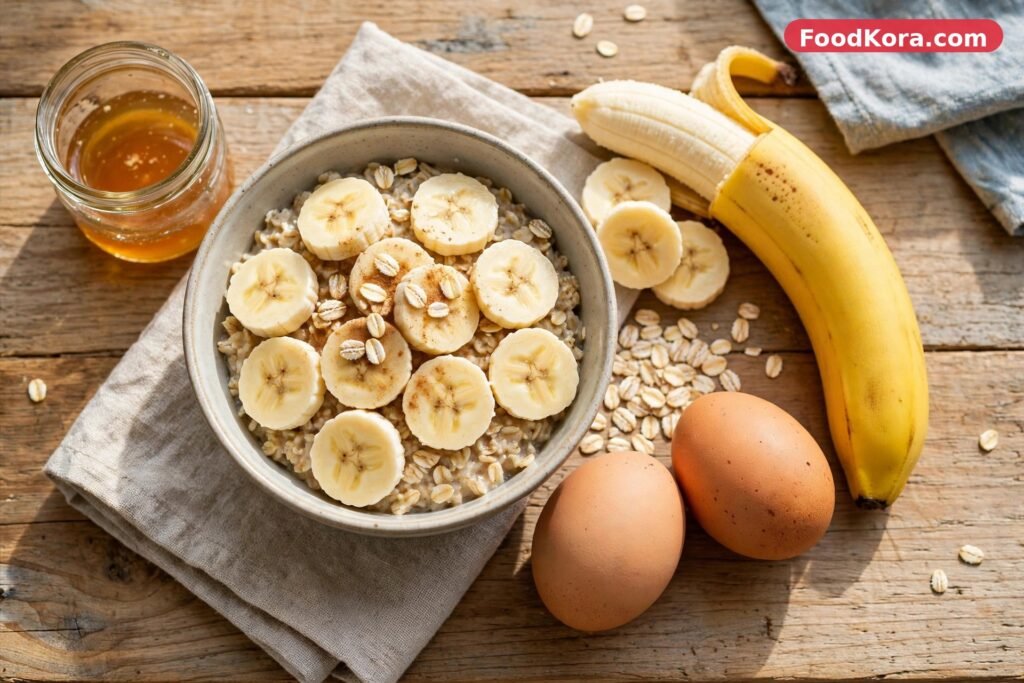
Oats with banana is the cheapest breakfast in this guide, and it is also one of the most filling. It takes about five minutes, needs only three main ingredients, and keeps you full for hours.
Put half a cup of rolled oats and one cup of milk or water in a small saucepan over medium heat. Stir now and then for about four minutes, until the mixture thickens and the oats soften. Take the pan off the heat and stir in a sliced banana and a drizzle of honey. The banana melts slightly into the oats and sweetens them naturally, so you need very little honey at all.
Serve in a warm bowl, with a spoonful of peanut butter stirred in if you have it. Peanut butter adds protein and makes the bowl richer, but the recipe works perfectly well without it. If you are really rushed, the same oats can be made in the microwave in about two minutes, stirred halfway through. Just use a large bowl, because oats bubble up as they cook.
This is also a good recipe for using bananas that are getting soft. A speckled banana is sweeter than a firm one, which means you need even less honey. Nothing is wasted, and the breakfast tastes better for it.
Recipe 2: Egg on Toast, Done Properly
Egg on toast is cheap, fast, and far more satisfying than it sounds, as long as the egg is cooked well and the toast is crisp. It takes about five minutes and needs only bread, an egg, and a little butter or oil.
Toast two slices of bread until golden. Wholemeal bread is a good choice because it keeps you fuller for longer, but any bread you have will do. While the toast browns, fry one or two eggs in a lightly oiled pan over medium heat, until the whites are set and the yolks are cooked the way you like them. Season with salt and pepper.
Place the eggs on the buttered toast and finish with a pinch of chilli flakes, a few herbs, or a sliced tomato on the side. The whole meal costs very little, yet it feels like a proper breakfast rather than a snack. For more quick morning ideas built on the same simple ingredients, see our quick and easy breakfast (https://foodkora.com/quick-and-easy-breakfast/) guide.
If you have leftover vegetables, fry a handful of spinach or mushrooms in the same pan before the eggs go in. The vegetables add flavour and bulk for almost no extra cost, and they turn a simple plate into a more complete meal.

Recipe 3: Peanut Butter Toast with Fruit
Peanut butter toast is the cheapest breakfast you can make without cooking anything at all. It takes about three minutes, travels well, and keeps you full far longer than a plain slice of toast or a sugary cereal bar.
Toast a slice or two of bread until crisp, then spread generously with peanut butter while the toast is still warm, so the peanut butter softens slightly. Top with sliced banana, or apple slices if bananas are not in season. A drizzle of honey or a sprinkle of cinnamon is optional, but the combination already tastes good without either.
The reason this works so well is balance. The bread gives you energy, the peanut butter gives you protein and staying power, and the fruit gives you freshness. Together they make a breakfast that costs very little per serving but still feels complete. It is also easy to eat on the go, wrapped in foil or a small container, which makes it a lifesaver on rushed mornings.
For variety, try almond butter if it is on offer, or add a few raisins or seeds on top. The formula stays the same: toast, spread, fruit. Change one element and you have a different breakfast for no extra effort.
Recipe 4: Rice Porridge with Egg
Rice porridge, sometimes called congee, is one of the cheapest hot breakfasts in the world. It turns a small amount of leftover rice into a warm, comforting bowl, and it is a brilliant way to use rice that would otherwise go to waste.
Put one cup of cooked rice in a saucepan with two cups of water or stock and a pinch of salt. Simmer over low heat for about ten minutes, stirring now and then, until the rice breaks down into a thick, creamy porridge. Add a little more water if it gets too thick. The texture should be soft and spoonable, not dry.
Meanwhile, boil or fry an egg. Halve a boiled egg and place it on top of the porridge, then finish with a drizzle of soy sauce, a few spring onion slices, and a pinch of chilli flakes if you like heat. The egg makes the porridge filling, and the toppings give it flavour for almost no extra cost.
This recipe is endlessly flexible. Leftover chicken, a spoonful of beans, or a handful of frozen vegetables can all be stirred in. Whatever you add, the base stays the same: rice, water, salt, and time. It is hard to find a cheaper hot breakfast that tastes this good.
Recipe 5: Bean and Egg Breakfast Wrap
A bean and egg wrap is cheap, filling, and easy to eat on the move. It uses tinned beans, which are among the lowest-cost proteins available, plus eggs and a flatbread or tortilla. One tin of beans and three eggs can feed two people generously.
Warm a tin of beans in a small pan with a pinch of cumin and paprika, mashing a few of them lightly so the mixture thickens. Meanwhile, scramble three eggs in a buttered pan over medium-low heat, stirring slowly until soft curds form. Season with salt and pepper.
Lay a large flatbread or tortilla flat and spoon the beans down the middle, then add the scrambled eggs and a spoonful of salsa or grated cheese if you have it. Roll up firmly, starting from one edge, and wrap in foil if you are taking it with you. The whole thing takes about ten minutes, including cooking the eggs and beans.
This wrap is also a good packed breakfast, since it holds together well and tastes good warm or at room temperature. Make two at once if you can: one for today and one for tomorrow, kept wrapped in the fridge and warmed briefly in the morning.
Recipe 6: Homemade Oat Muffins
Homemade muffins cost a fraction of bought ones, and a single batch gives you breakfast for most of the week. They take about thirty minutes on a weekend, and then mornings take care of themselves.
Mash two ripe bananas in a bowl. Stir in two eggs, a quarter cup of honey or sugar, and a quarter cup of oil. Add one and a half cups of rolled oats, one cup of flour, one teaspoon of baking powder, and a pinch of salt. Mix until just combined, then spoon into a lined muffin tin.
Bake at 180 degrees Celsius for about eighteen to twenty minutes, until the tops are golden and a toothpick comes out clean. Let them cool, then store in an airtight container for up to four days, or freeze for up to a month. In the morning, grab one cold or warm it for twenty seconds in the microwave.
These muffins are forgiving, which is why they suit beginners. If you add raisins, seeds, or a spoonful of peanut butter, they still work. If you swap the bananas for grated apple, they still work. The recipe is more of a template than a strict set of rules, and that is exactly what makes it useful for a tight budget.

Money-Saving Tips for Every Breakfast
The biggest saving is planning. Before you shop, check what is already in the cupboard and build breakfasts around it. A week where you use up the oats, eggs, and bananas you already own costs far less than a week where you buy new ingredients for every recipe. A short shopping list, written before you leave the house, stops impulse buys that quietly inflate the bill.
Store food properly, because wasted food is wasted money. Keep oats in a sealed jar, bread in a cool dry place or the freezer, and eggs in the fridge. Freeze bananas that are going soft, and freeze bread in slices so you can toast exactly what you need. Small storage habits add up to real savings over a month.
Finally, cook in batches whenever you can. A double batch of muffins, a large pot of porridge, or a tray of baked oats costs little extra effort and gives you several breakfasts for the price of one cooking session. General healthy eating guidance, such as the USDA MyPlate (https://www.myplate.gov/) advice to build meals around grains, fruits, and protein foods, still applies when you are cooking on a budget. Cheap does not have to mean unbalanced, and a plate with oats, fruit, and an egg is a good example of a low-cost meal that covers the bases.
If mornings are your main struggle, our guide to the easiest breakfast recipes (https://foodkora.com/easiest-breakfast-recipes/) covers more simple options that use the same cheap pantry staples, so you can rotate them without spending more.
You May Also Like
- Easy Meal Recipes (https://foodkora.com/easy-meal-recipes/)
- Quick and Easy Breakfast Ideas (https://foodkora.com/quick-and-easy-breakfast/)
- Easiest Breakfast Recipes (https://foodkora.com/easiest-breakfast-recipes/)
Frequently Asked Questions
What is the cheapest healthy breakfast?
Oats with banana is usually the cheapest healthy breakfast, since oats and bananas both cost very little per serving and the combination is filling. Egg on toast is a close second. Both pair a grain with protein or fruit, which is what keeps you full until lunch.
How can I make breakfast cheaper without skipping it?
Start by building breakfasts around ingredients you already own, especially oats, eggs, bread, and rice. Buy larger packs of staples when they are on offer, use seasonal or frozen fruit, and cook in batches so one cooking session covers several mornings.
Is it cheaper to make breakfast at home than to buy it?
Yes, almost always. A homemade bowl of oats or egg on toast costs a small fraction of a cafe breakfast or a bought pastry, and it is usually more filling too. Even allowing for the cost of ingredients, home cooking wins by a wide margin over a month.
What cheap breakfast keeps you full the longest?
Breakfasts that combine protein with fibre tend to last longest. Eggs with wholemeal toast, oats with peanut butter, or a bean and egg wrap all keep hunger away far better than a sugary cereal or a plain pastry, because protein and fibre digest more slowly.
Can I eat cheap breakfasts every day without getting bored?
Yes, if you rotate a few recipes instead of eating the same one daily. Oats one day, eggs the next, and a wrap the day after already feels like variety, even though the ingredients barely change. Swapping the fruit, the spread, or the topping is enough to keep things interesting.
Conclusion
Cheap breakfast recipes do not have to taste cheap. Oats with banana, egg on toast, peanut butter toast, rice porridge, a bean and egg wrap, and a batch of homemade muffins all prove the point: simple ingredients, cooked simply, make breakfasts that are filling, tasty, and kind to your budget.
Start with the recipe that uses what you already have in the kitchen. Once one cheap breakfast becomes a habit, the savings add up quietly, week after week, without any feeling of going without. For more balanced eating ideas on any budget, the NHS healthy eating guide (https://www.nhs.uk/live-well/eat-well/how-to-eat-a-balanced-diet/eating-a-balanced-diet/) is a helpful reference.
Sources
- USDA MyPlate: https://www.myplate.gov/
- NHS – Eating a balanced diet: https://www.nhs.uk/live-well/eat-well/how-to-eat-a-balanced-diet/eating-a-balanced-diet/


