
Some desserts are built for a crowd, and that is exactly the problem. A full cake for two people means days of leftovers going stale, a tray of brownies means temptation at every hour, and a whole pie can sit in the fridge until nobody wants it anymore. Small dessert recipes solve that problem by scaling the sweet ending down to the people actually eating it.
Cooking dessert for one or two is not just about halving a recipe and hoping for the best. Small desserts have their own logic. They cook faster, they need smaller dishes, and they can be more generous with toppings because there is only one serving to dress up. A single ramekin of warm pudding, eaten straight from the oven, feels more special than a slice cut from a cake that has been sitting around for three days.
This guide collects six original small dessert recipes that serve one or two people, plus practical tips for scaling, storing, and choosing the right dish. Every recipe uses everyday ingredients, takes thirty minutes or less, and leaves no mountain of leftovers behind. Pick one tonight, and enjoy dessert at exactly the right size.
Why Do Small Desserts Work So Well for One or Two?
The first reason is simple: freshness. A dessert made fresh for one or two people is eaten at its best, warm from the oven or just set from the fridge, instead of being a leftover from a bigger batch. There is no second-day slice, no dried-out edge, and no guessing whether it is still good.
The second reason is portion control without feeling deprived. A small dessert is a complete dessert, not a sad half-portion. A ramekin pudding, a single mug cake, or a mini crumble for two is a proper sweet ending, served in a dish that suits it. You enjoy every spoonful instead of stopping halfway through a giant serving you never really wanted.
Small desserts are also cheaper and faster. They use fewer ingredients, they cook in minutes rather than an hour, and they need far less washing up. A mug and a spoon, or two ramekins and a baking tray, is the whole operation. For a quiet evening at home, that is exactly the right amount of effort.
What Dishes Do You Need for Small Desserts?
You do not need special equipment, but two or three small dishes make everything easier. Ramekins are the workhorse of small desserts: they go in the oven, they look good on the table, and they hold exactly one serving. A set of four covers most recipes in this guide.
Large mugs are the other essential. A mug cake, a warm crumble, or a layered dessert can all be built in a mug, and the mug doubles as the serving dish. Choose mugs that are microwave-safe and big enough that a rising cake does not spill over the top.
Small baking dishes, about the size of a large saucer, are useful for crumbles and baked fruit for two. A single ovenproof dish shared between two people feels generous, while still being far smaller than a full baking tray. If you have ramekins, mugs, and one small dish, you have everything these recipes need.
How Do You Scale a Dessert Down Without Ruining It?
Scaling down is not always a matter of dividing everything by four. Baking powder, for example, does not scale perfectly: a quarter of a teaspoon is hard to measure and easy to get wrong. For small desserts, it is better to use recipes written for one or two servings, like the ones below, than to shrink a large recipe and hope the chemistry still works.
Cooking time is the other thing that changes. A small pudding cooks much faster than a large one, sometimes in half the time. Start checking five minutes before the recipe says it should be done, and look for the signs of readiness — set edges, a slight wobble in the middle, a golden top — rather than relying on the clock alone.
Eggs are the trickiest ingredient to scale, because you cannot easily use a quarter of an egg. The recipes below avoid that problem by using whole eggs for two servings, or by skipping eggs entirely for single servings. If you ever adapt a larger recipe yourself, use a whole small egg and slightly reduce the other wet ingredients to balance it.
Recipe 1: Single Chocolate Mug Pudding
A chocolate mug pudding is the fastest small dessert there is, and it is made for one person on a quiet evening. It takes about five minutes, it uses one mug, and it is eaten warm with a spoon.
In a large microwave-safe mug, stir together three tablespoons of flour, two tablespoons of sugar, one tablespoon of cocoa powder, and a pinch of baking powder. Add three tablespoons of milk, one tablespoon of oil, and a few drops of vanilla, and stir until just combined. Drop a small square of chocolate into the middle for a molten centre.
Microwave on high for about seventy seconds, then check. The pudding should look set on top but still slightly soft underneath. If it is not ready, cook for ten more seconds at a time. Overcooking is the only real risk, and it turns a soft pudding dry very quickly, so stop early rather than late.
Let it stand for one minute, then eat straight from the mug, topped with a spoonful of yogurt, a few berries, or a dusting of cocoa. One mug serves one person generously. If two people want dessert, make two mugs — it takes no longer than making one.
Recipe 2: Baked Apple Ramekins for Two
Baked apples in ramekins are the small dessert for a cold evening. They smell wonderful, they feel comforting, and they use apples that might otherwise sit in the fruit bowl for another week.
Heat the oven to 190 degrees Celsius. Peel and dice two apples into small pieces. Toss them with a teaspoon of cinnamon, a teaspoon of sugar, and a squeeze of lemon juice. Divide the mixture between two buttered ramekins, and dot a small knob of butter over the top of each one.
For the topping, rub one tablespoon of cold butter into three tablespoons of flour and two tablespoons of oats until the mixture looks like crumbs. Stir in a tablespoon of sugar, then sprinkle the topping evenly over the apples in both ramekins.
Bake for twenty to twenty-five minutes, until the topping is golden and the apples are soft and bubbling underneath. Serve warm, straight from the ramekins, with a spoonful of yogurt or cream. Two ramekins serve two people perfectly, with no leftovers and no sharing disputes.
Recipe 3: Two-Person Berry Crumble
A berry crumble for two is the same idea as the baked apples, but lighter and fruitier. It works with fresh or frozen berries, which makes it a dessert you can make in any season without a special shopping trip.
Heat the oven to 190 degrees Celsius. Put two cups of mixed berries — fresh or frozen — into a small ovenproof dish. Toss with a teaspoon of sugar and a teaspoon of cornflour, which helps the fruit juices thicken as they bake instead of running everywhere.
Make the crumble topping by rubbing two tablespoons of cold butter into four tablespoons of flour and three tablespoons of oats, then stirring in two tablespoons of sugar. Sprinkle the topping over the berries, covering them evenly but not packing it down too firmly.
Bake for twenty minutes, until the topping is golden and crisp and the berries are bubbling at the edges. Let it cool for five minutes, then serve in bowls with yogurt or cream. One small dish serves two people, and it tastes like a full-sized crumble in miniature.
Recipe 4: Single-Serve No-Bake Cheesecake Cup
A single cheesecake cup is the no-bake small dessert for evenings when you do not want the oven on at all. It takes ten minutes of work plus an hour in the fridge, and it is portioned for exactly one person.
Crush three plain biscuits into fine crumbs and mix with a teaspoon of melted butter. Press the mixture into the bottom of a small glass or jar. This is your base, and it does not need to be perfect — a slightly uneven base still tastes great under the filling.
Beat 100 grams of soft cream cheese with a tablespoon of icing sugar and a few drops of vanilla until smooth. Fold in two tablespoons of whipped cream, then spoon the filling over the biscuit base and smooth the top. Refrigerate for at least one hour, or overnight if you are planning ahead.
Before serving, top with a spoonful of berries, a drizzle of honey, or a little lemon zest. One cup serves one person, and it looks elegant enough for a guest. Double the quantities across two glasses if you are cooking for two.

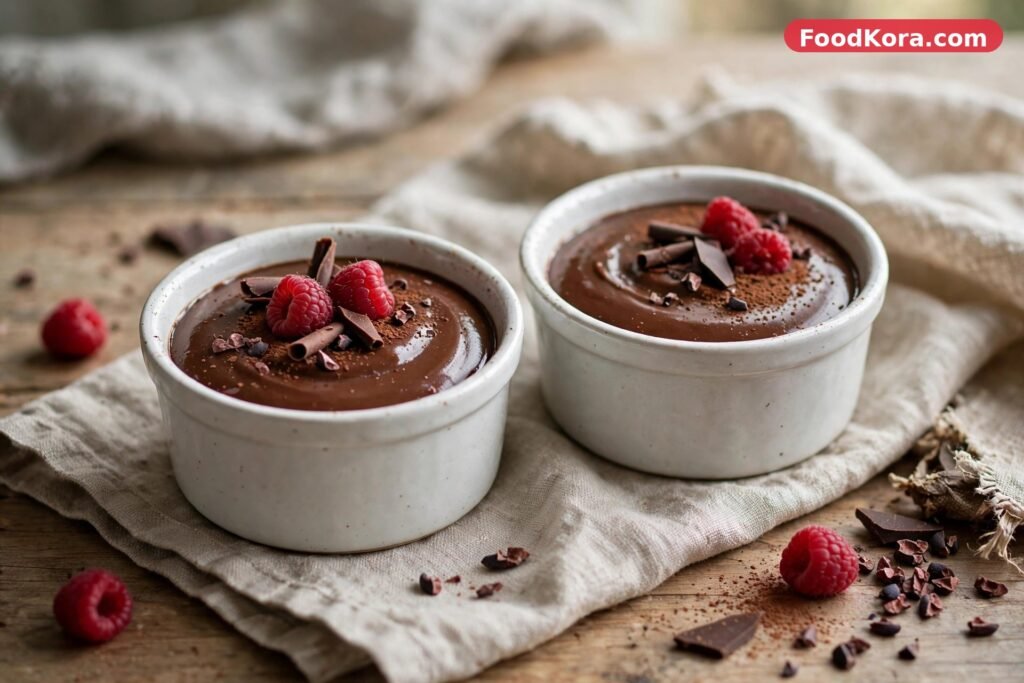
Recipe 5: Two Chocolate Pots
Chocolate pots are the small dessert that feels the most luxurious, because they are rich, dark, and served in small portions. Two pots, made in ten minutes, are a perfect ending to a dinner for two.
Warm half a cup of cream in a small saucepan until it just starts to steam. Pour it over 100 grams of chopped dark chocolate in a bowl, wait for two minutes, then stir gently from the centre outwards until the mixture is smooth and glossy. Stir in a pinch of salt and a few drops of vanilla.
Divide the mixture between two small ramekins, cups, or espresso cups. Refrigerate for at least one hour, until set but still soft enough to spoon. The pots should be firm at the edges and slightly soft in the middle, like a very thick mousse.
Serve with a few berries, a dusting of cocoa, or a small biscuit on the side. Chocolate pots are rich, so a small portion is plenty, and two pots are exactly the right amount for two people. They keep in the fridge for two days, though they rarely last that long.
Recipe 6: Warm Pear and Honey for One
Warm pear and honey is the simplest small dessert in this guide, and it is the one for evenings when you want something sweet but light. It takes ten minutes, uses one pear, and needs only a frying pan.
Peel a ripe pear, cut it in half, and remove the core. Warm a small knob of butter in a frying pan over medium heat, place the pear halves cut-side down, and cook for about four minutes until golden underneath. Turn them over, drizzle with a teaspoon of honey, and cook for two more minutes until the pear is soft and the honey is warm and syrupy.
Serve the pear halves warm, with a spoonful of yogurt or a small scoop of ice cream. A sprinkle of cinnamon or a few chopped nuts on top adds warmth and crunch. One pear serves one person, or two people sharing a light dessert after a large meal.
This recipe is easy to change. Swap the pear for a peach or an apple, swap the honey for maple syrup, or add a pinch of ginger to the pan. Whatever version you make, it is ready in minutes and leaves nothing behind but a pan to wash.

What If a Small Dessert Goes Wrong?
Small desserts are forgiving, but a few things can still go sideways. A mug pudding that overcooks turns dry, but a spoonful of yogurt or cream on top softens it again. A crumble topping that browns too fast can be covered loosely with foil for the last few minutes of baking, which stops the burning without spoiling the crunch.
A no-bake cup that will not set usually just needs more time in the fridge. Give it another hour before deciding anything is wrong, because cream cheese fillings firm up late. If it is still soft, serve it in the glass as a creamy dessert rather than trying to unmould it — a soft cheesecake cup is still a good dessert.
The general lesson is the same as for any dessert: do not panic. Small desserts use small quantities, so a mistake costs very little, and most of them can be rescued with cream, yogurt, or a change of serving dish. Confidence matters more than precision, and each small dessert you make teaches you something for the next one.
How Do You Store Leftovers from Small Desserts?
The best thing about small desserts is that there usually are no leftovers. But when there are — a second ramekin saved for tomorrow, or a chocolate pot made ahead — storage is simple. Cover the dish tightly and refrigerate for up to two days. Cream-based desserts should stay covered, because they pick up fridge smells quickly.
Baked fruit desserts, like the apple ramekins and berry crumble, reheat well. A minute or two in the microwave, or ten minutes in a warm oven, brings them back to life. No-bake cups and chocolate pots should be served cold, straight from the fridge, after a few minutes at room temperature to soften slightly.
If you regularly cook for one, it is worth keeping a few small dishes ready and a short list of your favourite single-serve recipes on the fridge. That way, dessert never becomes a project — it stays a small, easy pleasure at the end of the day. For more simple everyday cooking, our guide to easy meal recipes (https://foodkora.com/easy-meal-recipes/) covers straightforward meals for any evening, while easy chocolate desserts (https://foodkora.com/easy-chocolate-desserts/) shows how chocolate works at any scale. If mornings need the same small-batch thinking, sweet breakfast recipes (https://foodkora.com/sweet-breakfast-recipes/) has ideas for one or two.
You May Also Like
- Easy Meal Recipes (https://foodkora.com/easy-meal-recipes/)
- Easy Chocolate Desserts (https://foodkora.com/easy-chocolate-desserts/)
- Sweet Breakfast Recipes (https://foodkora.com/sweet-breakfast-recipes/)
Frequently Asked Questions
What is the easiest small dessert for one person?
A chocolate mug pudding is the easiest, taking about five minutes with one mug and no oven. A warm pear with honey is nearly as fast, and a yogurt-based dessert needs no cooking at all. All three are portioned for one person and leave almost no washing up.
Can I halve a normal dessert recipe to serve one or two?
Sometimes, but not always. Recipes written for one or two servings, like the ones in this guide, are more reliable than halving a large recipe, because baking powder and eggs do not scale neatly. When you do adapt a recipe, watch the cooking time closely, since small portions cook much faster.
What size ramekins should I use for small desserts?
Standard ramekins holding about 150 to 200 millilitres are ideal for single servings. They go in the oven, they look good on the table, and they hold exactly one portion. Larger ramekins work for two people sharing, but a standard size is the most useful to own.
How do I know when a small baked dessert is done?
Look for set edges, a slight wobble in the middle for puddings and chocolate pots, and a golden top for crumbles. Start checking five minutes before the recipe time, because small desserts cook faster than large ones. A skewer or knife inserted in the centre should come out mostly clean for baked desserts.
Can I make small desserts ahead of time?
Yes, several small desserts are ideal made ahead. No-bake cheesecake cups and chocolate pots set in the fridge and taste better after a few hours. Baked fruit desserts can be assembled earlier and baked just before serving. Mug puddings are best made fresh, but they only take five minutes anyway.
Conclusion
Small dessert recipes prove that a sweet ending does not need to feed a crowd. A single mug pudding, two ramekins of baked apples, a berry crumble for two, a cheesecake cup, two chocolate pots, or a warm pear with honey — each one is scaled to the people eating it, ready in thirty minutes or less, and leaves no stale leftovers behind.
Start with the recipe that suits tonight: a mug pudding for one, or a crumble for two. Once small desserts become a habit, dessert stops being a project and becomes a small pleasure at the end of the day, exactly the right size. For general balanced eating guidance, the USDA MyPlate (https://www.myplate.gov/) recommendations are a helpful reference.
Sources
- USDA MyPlate: https://www.myplate.gov/
- NHS – Eating a balanced diet: https://www.nhs.uk/live-well/eat-well/how-to-eat-a-balanced-diet/eating-a-balanced-diet/